How to connect Obsidian to Cursor
Cursor’s Agent can search, read and edit your Obsidian notes once you add Shard Connector as a remote MCP server. One URL and a Google sign-in make the vault available in the editor, the Cursor CLI and Cloud Agents. Shard Connector reads your vault through Obsidian Sync, so you don’t need the Local REST API plugin or an open copy of Obsidian.
Updated
Before you start
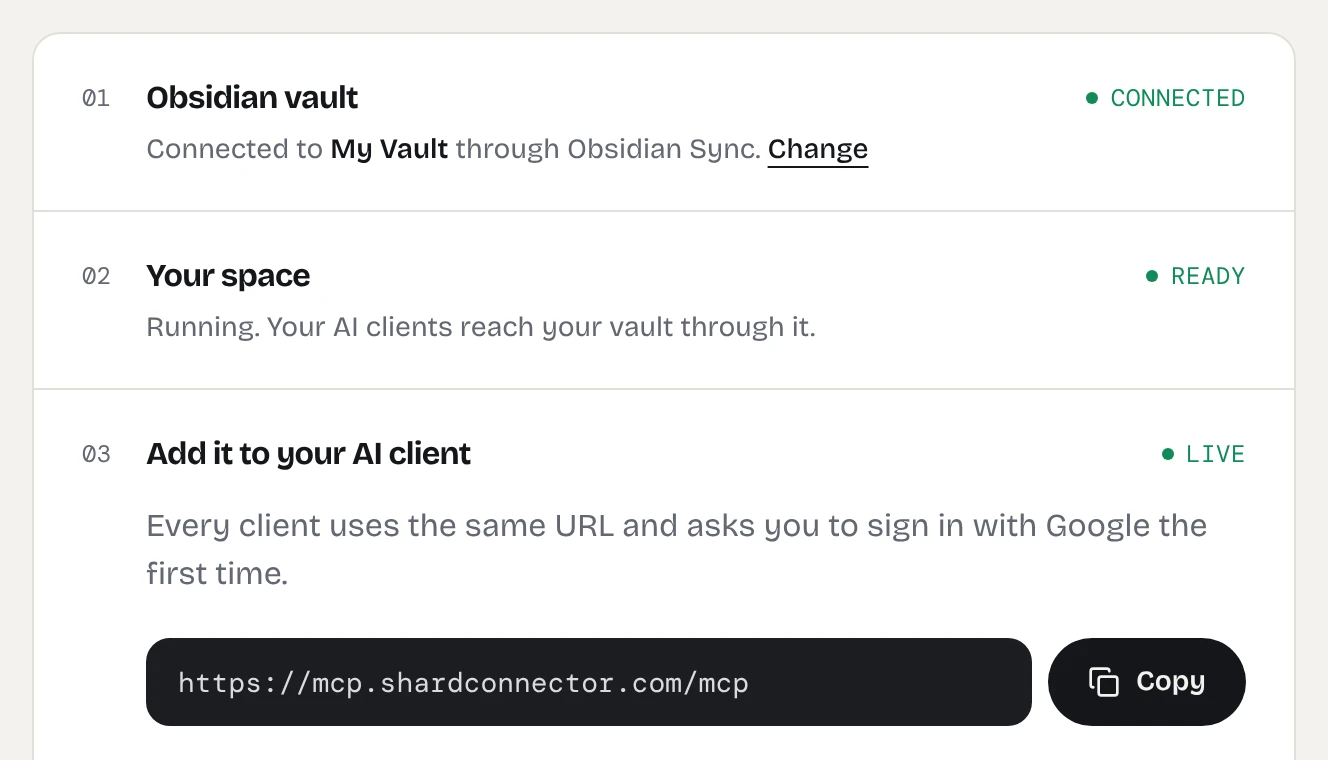
You need an Obsidian vault you sync with Obsidian Sync, and a Shard Connector space with that vault connected. Sign in with Google to set it up: it’s $2.99 a month after a 5-day free trial. For Cursor:
- Cursor’s desktop app, or the Cursor CLI.
- For Cloud Agents, a Cursor plan that includes them.
When your dashboard shows the space as ready, copy the server URL. It’s the same for everyone; the Google sign-in decides whose vault Cursor reaches.
https://mcp.shardconnector.com/mcp
Add Obsidian to Cursor
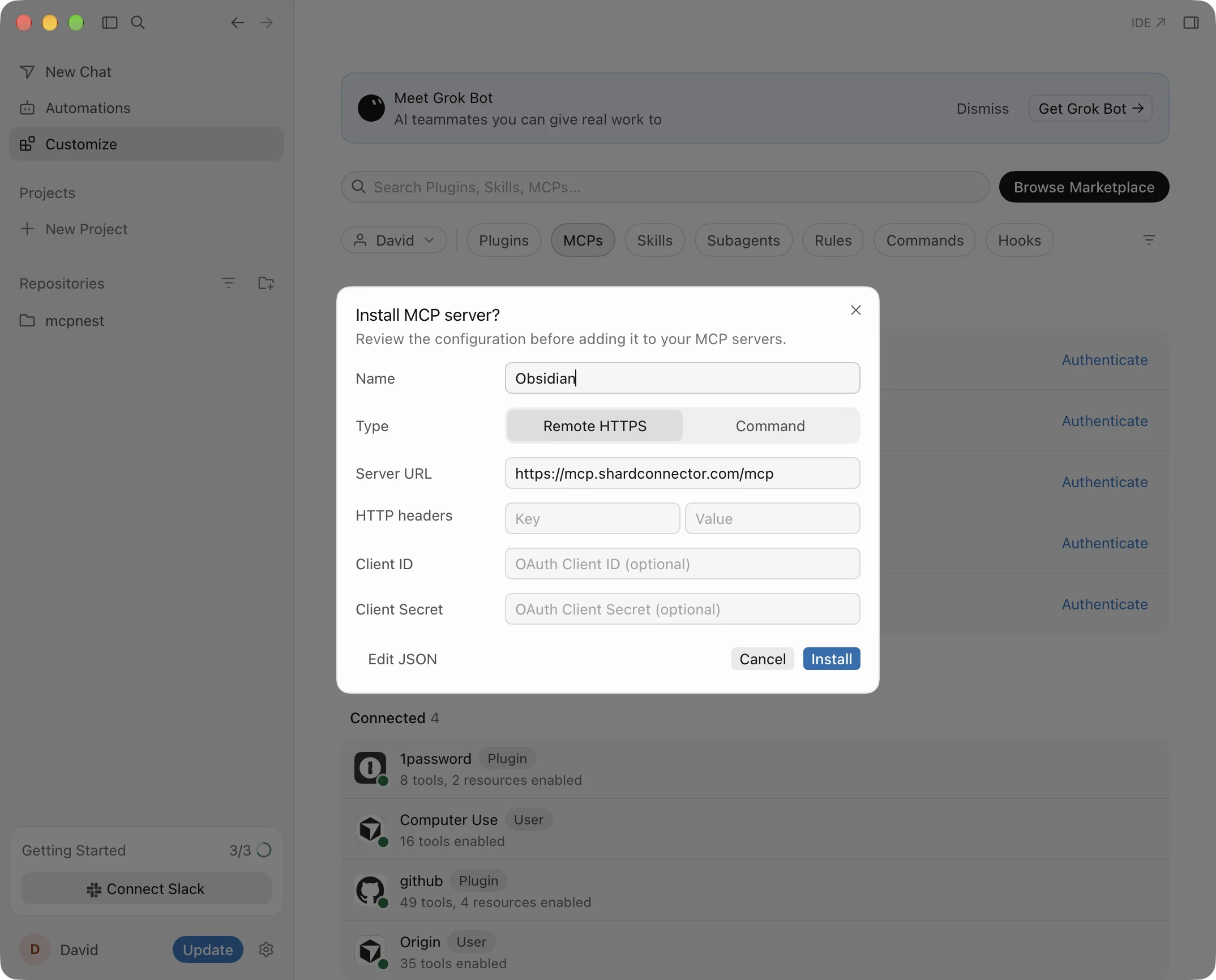
The quick way: Add to Cursor opens Cursor and asks you to install the server. Click Install and carry on from step 2.
-
Add the server to mcp.json
Open
~/.cursor/mcp.json, or create it, and add anObsidianentry. In your home folder it applies to every project. A.cursor/mcp.jsoninside a project limits it to that project.{ "mcpServers": { "Obsidian": { "url": "https://mcp.shardconnector.com/mcp" } } } -
Sign in
Open Customize in Cursor’s sidebar and choose MCPs.
Obsidianis listed under Needs Attention. Click Authenticate next to it. If the list is long, type Obsidian into the search box.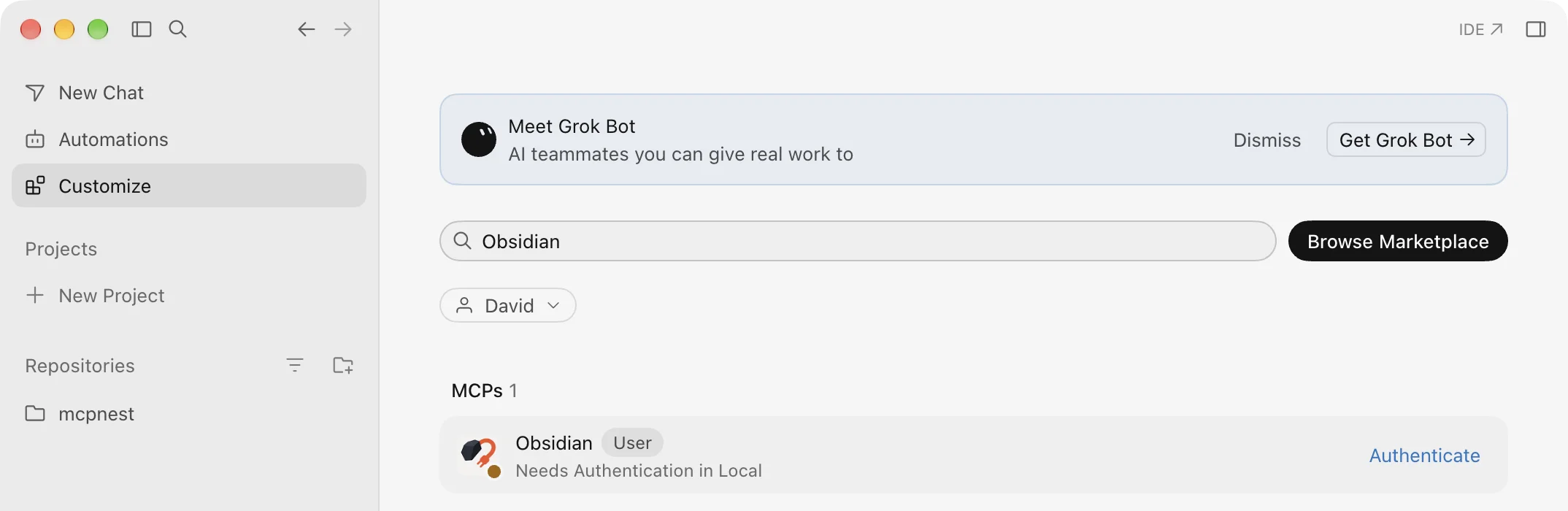
Your browser opens a Shard Connector page asking you to allow Cursor. Click Allow and sign in with the Google account you use on this site.
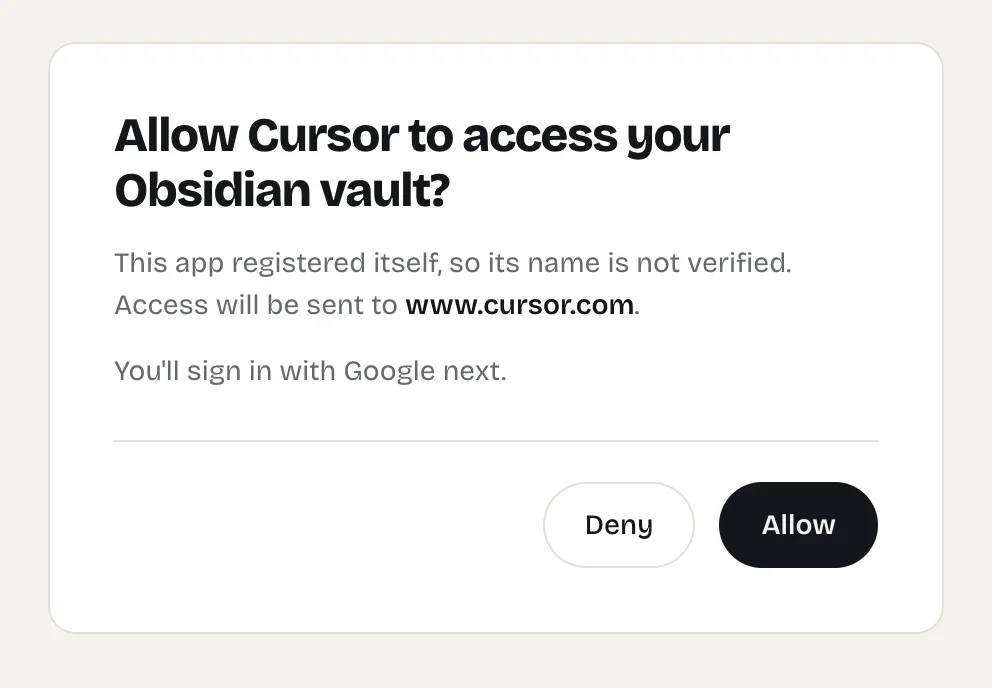
The Shard Connector page Cursor opens when you click Authenticate. Back in Cursor,
Obsidianshows 11 tools enabled. Click it to see that the one sign-in connected both Local and Cloud.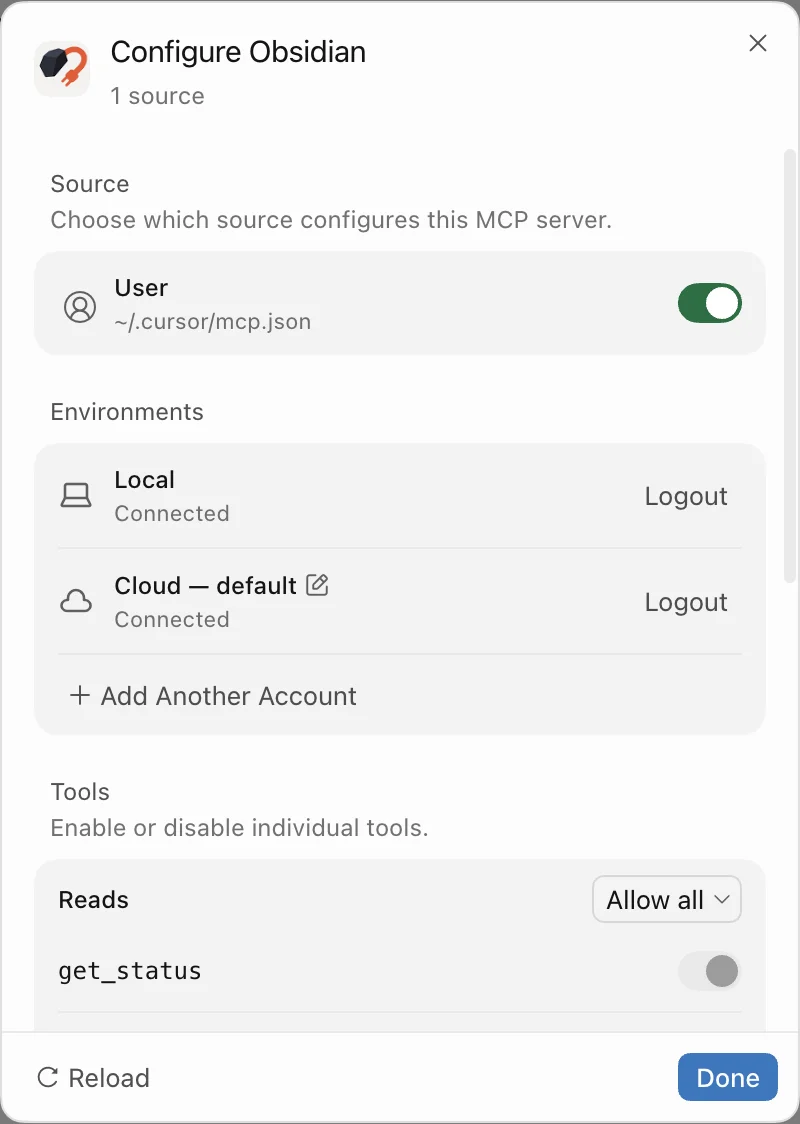
-
Ask Agent about your notes
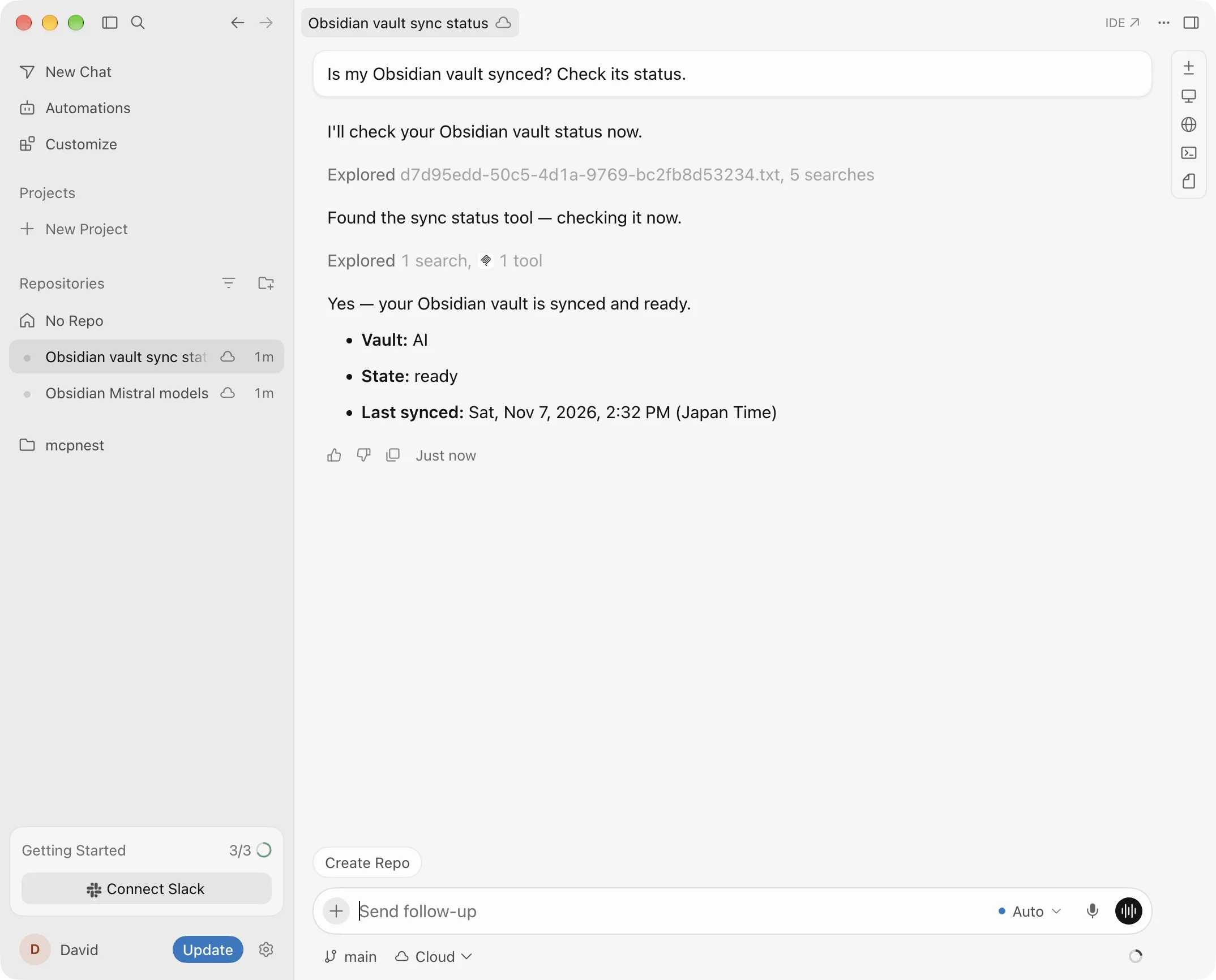
Open a chat and mention your vault, for example “Search my Obsidian vault for my notes on the billing redesign.” Depending on your approval settings under Cursor Settings, Agents, Agent runs the vault’s tools on its own or asks you first.
Cloud Agents and the CLI
Cloud Agents run on Cursor’s machines, so they can’t reach a server on your laptop, but they can use a hosted one. Signing in from the desktop app connects the Cloud environment too, so agents you start with Cloud selected can use the vault right away. On the web, add the server URL from the MCP dropdown at cursor.com/agents and sign in there.
The CLI reads the same mcp.json. Run agent mcp login Obsidian once to sign in.
Things to ask
- “Read my Obsidian note on the API design and check this code against it.”
- “Add today’s release notes to my Changelog note in Obsidian.”
- “Search my vault for meeting notes that mention the payments team.”
Hosted or local
The usual local setup is the Local REST API plugin with a local MCP server such as mcp-obsidian. It needs Obsidian open on the same computer and an API key in mcp.json, and it can’t serve Cloud Agents. Shard Connector is already hosted, so the same URL works on every computer and in the cloud. A local server keeps your notes on your own machine, which is the safer choice if that matters more to you. Obsidian MCP server: hosted or local? compares the options.
Troubleshooting
Obsidian shows an error or never asks you to sign in. Check that the URL is exactly https://mcp.shardconnector.com/mcp and that the entry uses url, not command. Then turn the server off and on again under Customize, MCPs.
Agent answers without using your notes. Mention your Obsidian vault in the prompt, and check that Obsidian is turned on under MCPs.
Sign-in says there’s no vault for your account. Check on your dashboard that your vault is connected and your subscription is active. If you signed in with a different Google account, click Obsidian under Customize, MCPs, click Logout on both the Local and Cloud rows and sign in again with the account you use on the dashboard.
What Cursor can do in your vault
Cursor works in the one vault you connected. It can search, read, create and edit notes and folders, and move notes to a Trash/ folder, but it can’t delete anything for good, see .obsidian or open images and PDFs. See the full list.
If Cursor says the vault is syncing, your space is waking up and catching up with Obsidian Sync. Wait a few seconds and ask again.
Questions
Do I need the Local REST API plugin?
No. Shard Connector reads and writes your vault through Obsidian Sync, so nothing has to run inside Obsidian.
Can I share the project’s mcp.json with my team?
Yes. The file holds only the URL. Each teammate signs in with their own Shard Connector account and reaches their own vault.